Tomato early blight, also known as target spot, is a common disease affecting the leaves, stems, and fruits of both greenhouse and open-field tomatoes. Typical lesions exhibit concentric rings, and the disease spreads rapidly under conditions of high humidity and poor ventilation. To control tomato early blight, fungicide application should be initiated at the early stage of disease onset, with the selection of appropriate protective and curative agents. Iprodione is a commonly used active ingredient, and Lanfeng Meiyin 50% Iprodione Wettable Powder is registered for the control of tomato early blight.
Early blight lesions exhibit concentric rings with distinct margins, primarily affecting leaves, stems, and fruits; late blight lesions initially appear water-soaked without concentric rings, and under high humidity, white mold develops on the fruit surface. The fungicides used for these two diseases are completely different (late blight requires oomycete-specific products), so misdiagnosis renders the application ineffective. If yellow-brown ring-patterned lesions first appear on lower older leaves, it is essentially early blight.
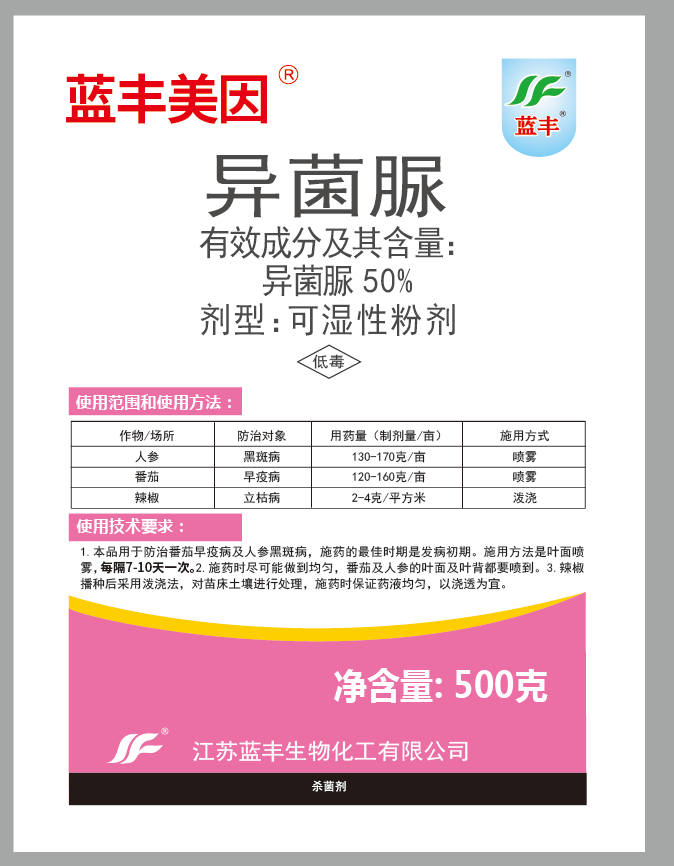
Iprodione is a dicarboximide fungicide that acts primarily by contact, with additional protective effects, and is effective against a wide range of fungal diseases, commonly used for early blight and gray mold. Its mode of action involves inhibiting spore germination and mycelial growth of the pathogen, and application at the early stage of disease development can suppress disease spread. Lanfeng Meiyin 50% Iprodione Wettable Powder is registered for the control of tomato early blight, with a recommended dosage of 120–160 g per mu (667 m²) applied as a foliar spray, starting at the early stage of disease onset, with applications repeated at intervals of 7–10 days.
The severe occurrence of early blight is often associated with high humidity and poor ventilation within the greenhouse, as well as dense foliage. In addition to fungicide application, it is essential to control humidity, promptly prune and remove lower aged or diseased leaves, and improve air circulation and light penetration among plants. When spraying, ensure thorough coverage of the abaxial leaf surfaces and stems—do not focus solely on the upper leaf surfaces. Before prolonged cloudy or rainy periods, apply a protective fungicide proactively; this is more effective than waiting until symptoms appear.
Iprodione should not be used consecutively too many times within a single growing season. It is recommended to rotate with other protectant fungicides such as chlorothalonil and mancozeb to delay the development of resistance. The specific application rate should follow the product label, as cropping patterns and climatic conditions vary by region.